Waydoo Evo Pro Plus Review
A Technical Review of the Waydoo Evo Pro Plus: Hardware Options and Configurations
The Waydoo Evo Pro Plus is a modular eFoil system featuring interchangeable parts. Understanding the exact mechanical differences between its setups allows users to evaluate its core utility.
Below is my objective breakdown of the hardware components, beginner versus advanced configurations, and the specific additions included in the "Plus" variation.
The Baseline Hardware Package
Regardless of the configuration selected, the fundamental package contains the components required for assembly:
The Board: The primary riding platform.
The Battery: The heaviest individual component, requiring a dedicated key (attached to the wrist strap) to lock into place.
Handheld Bluetooth Remote Controller: Displays speed and battery metrics, and includes a safety wrist strap.
Propulsion and Foil Assembly: Consists of a motor, a mast, a front wing, and a tail wing.
Modular Configurations: Beginner vs. Advanced Setup
The primary characteristic of this board is its mechanical adjustability. Modifying the configuration physically alters the stability, power consumption, and agility of the craft.
1. Stability and Length (The Tail Extender)
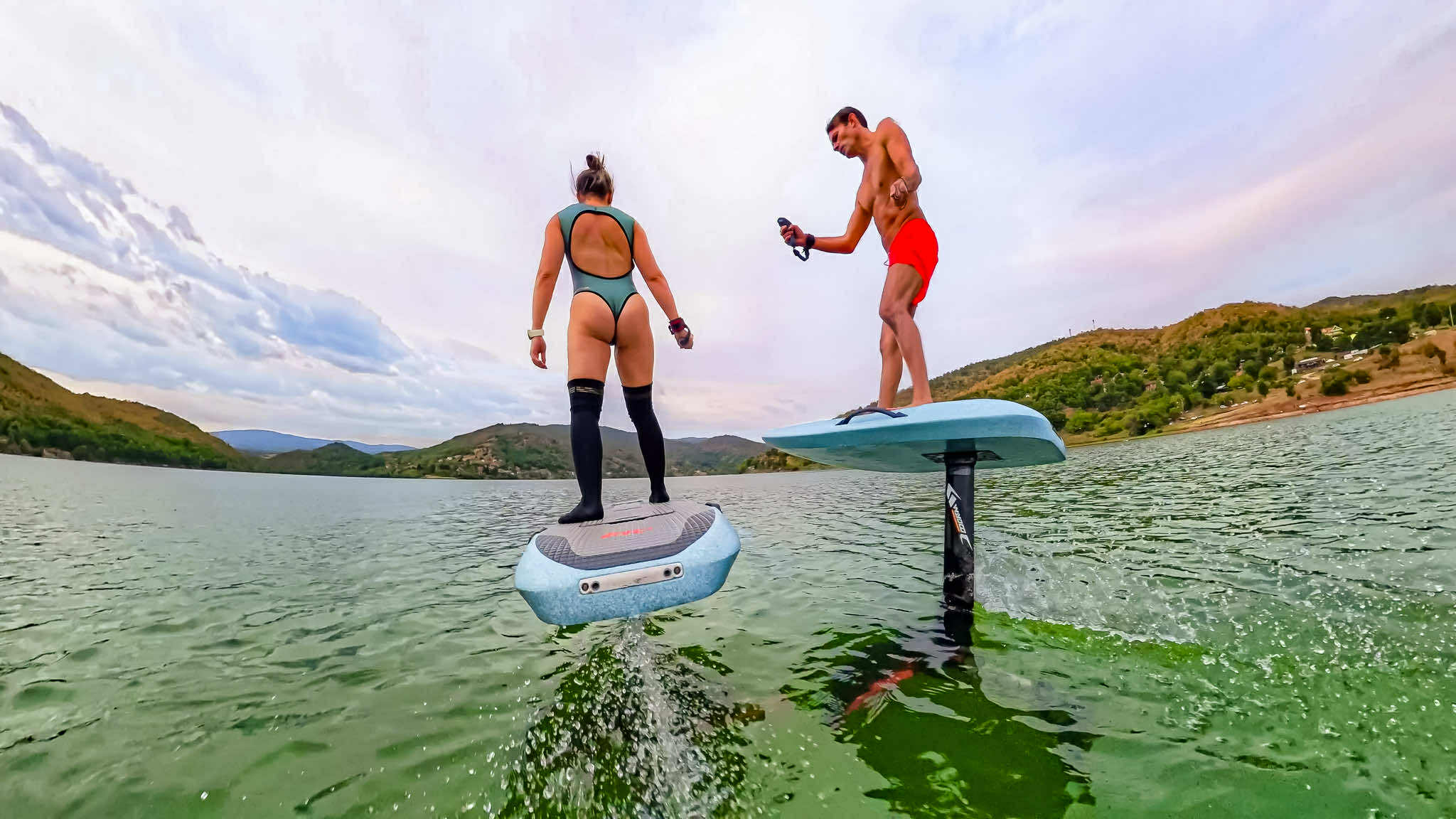
Beginners: Installing the tail extender pushes the rear wing further back. This increases the longitudinal footprint of the foil, resulting in greater pitch stability, though it makes the board harder to turn.
Advanced: Removing the tail extender shortens the distance between the front and rear wings, reducing stability but enabling sharper banking and quicker turns.
2. Height Options (The Mast)
The system supports multiple mast lengths, which dictate the board's height over the water:
Long Mast: I would recommend it for most environments. A longer mast provides a larger operational height window, reducing the risk of "breaching"—a situation where the propeller leaves the water, draws in air, loses lift, and causes the rider to fall. It also allows advanced riders to handle larger waves and carve more aggressively.
Short Mast: I recommend strictly for shallow environments, such as shallow lakes, where a long mast would strike the bottom.
3. Motor and Safety Options
Motors are available in two power ratings: 4 kW and 6 kW.
Propeller Guard: A protective mesh net can be installed over the propeller to prevent contact with the blades in a fall. While it improves safety for beginners, the mesh creates hydrodynamic resistance, which noticeably decreases total battery runtime.
Propeller Guard Eliminator: Advanced riders can swap the guard for a minimal cone. This reduces drag and optimises battery efficiency, but removes the safety barrier and leaves the board less inherently stable.
Folding Propeller: An optional aftermarket accessory that automatically folds its blades shut when the throttle is released. This allows the eFoil to glide freely on ocean swells using wave energy alone. It introduces significant instability, making it unsuitable for beginners.
4. Wing Profiles
The choice of front lifting wing changes the board's speed and handling:
Standard Wings: Provide baseline stability and predictable lift, making them optimal for learning.
Voyager 1100 Wing: A smaller, more streamlined wing that allows for higher speeds and sharper agility at the cost of initial stability.
Technical Features Specific to the "Plus" Model
The hardware distinguishes itself from standard iterations via a series of automated riding aids:
Ride-Assist Sensors: The "Plus" model is equipped with height and power sensors that automatically regulate thrust to assist the rider in transitioning from a boarding position to full flight.
Model Distinction: Standard (non-Plus) models lack these internal ride-assist sensors and are visually distinguished by a green color scheme instead of the Plus model's branding.
Additional Accessories and Form Factors
Volume Options: The system is evaluated on a standard 90-liter board. For heavier riders or dual-passenger riding, a larger 130-liter variant exists.
Mounting Points: The front nose of the board features integrated mounts intended for action cameras or an optional mechanical handlebar accessory.
Peripheral Gear: The unit does not ship with transport wheels or a protective travel bag by default; these must be sourced separately to prevent damage to the finish during overland transport. An optional inflatable tube accessory can also be fastened around the perimeter of the board to increase static buoyancy during mounting.
Waydoo Evo Efoil Discount code: MelanieEU
I can set you in contact with the dealer in your area
Waydoo Evo Pro Plus: In-Depth Buyer FAQs
Q: What is the Smart Flight Assistance System on the Evo Pro Plus, and does it work?
Yes, but it doesn't do the balancing for you. Waydoo’s Flight Assistance System uses built-in pitch sensors to automatically micro-adjust the motor's throttle to help you maintain a steady hover height above the water. Think of it like "lane assist" on a modern car—it nudges and stabilizes the board's pitch axis while you are cruising, which significantly reduces the learning curve for novice riders. However, it can be easily overpowered if you radically shift your weight, and it is highly recommended to turn the feature off if you are riding in large waves or heavy chop.
Q: How does the assembly process of the Evo Pro Plus compare to older Waydoo models?
The assembly process on the Evo Pro Plus requires more steps and patience than older generations like the Flyer One Plus. While the modularity is great for swapping components or upgrading parts down the line, it requires a bit more time on the shore to lock down the mast, battery bay, and wing setup correctly before a session. Additionally, the 90-liter EPP foam core layout is structurally solid but can feel cumbersome and heavy when maneuvering or carrying it to the shoreline completely solo.
Q: What are the real-world advantages of the upgraded Powerflight battery?
The updated battery cell architecture is one of the most practical upgrades on the Evo Pro Plus. Real-world range testing yields roughly 14 to 16 miles of riding on a single charge depending on your speed and wing choice, leaving a safe 20% buffer in the tank. The battery features an integrated display showing a real-time charge percentage on the water. A massive bonus is its reverse-charging capability, which allows you to use the massive eFoil battery pack as a power bank to fast-charge your phones, action cameras, or remote controllers directly at the beach.
Q: Is the standard propeller guard worth keeping on, or does it add too much drag?
The included prop guard and rear grate act like "training wheels" for a bicycle. It is a fantastic safety feature for total beginners because it protects against debris and accidental contact, and the added surface area helps stabilise the board during unexpected motor breaches. However, the guard creates noticeable fluid-dynamic drag and tracks heavily in a straight line. Once you progress past the novice stage and want to practice loose, playful carving or aggressive pendulum turns, removing the guard completely transforms the responsiveness of the board.
Q: Where is the safest place to order the Waydoo Evo Pro Plus to ensure a valid warranty?
To guarantee full warranty protection and avoid severe after-sales communication delays, you should always buy directly through regional authorised distributors (like Waydoo.tech) or a verified local dealer network rather than ordering directly from unverified overseas sites. Regional hubs provide identical baseline pricing but handle parts replacement, local freight protection, and component support vastly faster if an electronic component or remote link encounters a fault.