Waydoo Evo Pro Plus VS JetWave Carbon 100
Propulsion technology is rapidly rewriting the rulebook for the eFoil industry. By introducing direct-drive internal jet units alongside traditional propellers, manufacturers are offering riders a drastically quieter, smoother, and safer experience on the water.
In this head-to-head comparison, I am pinning two options against each other: the entry-level Waydoo Evo Pro Plus and the premium JetWave Carbon 100. While both feature 80 cm masts, their structural engineering, battery tech, and overall performance separate them into entirely different classes.
Technical Specifications: The On-Paper Setup
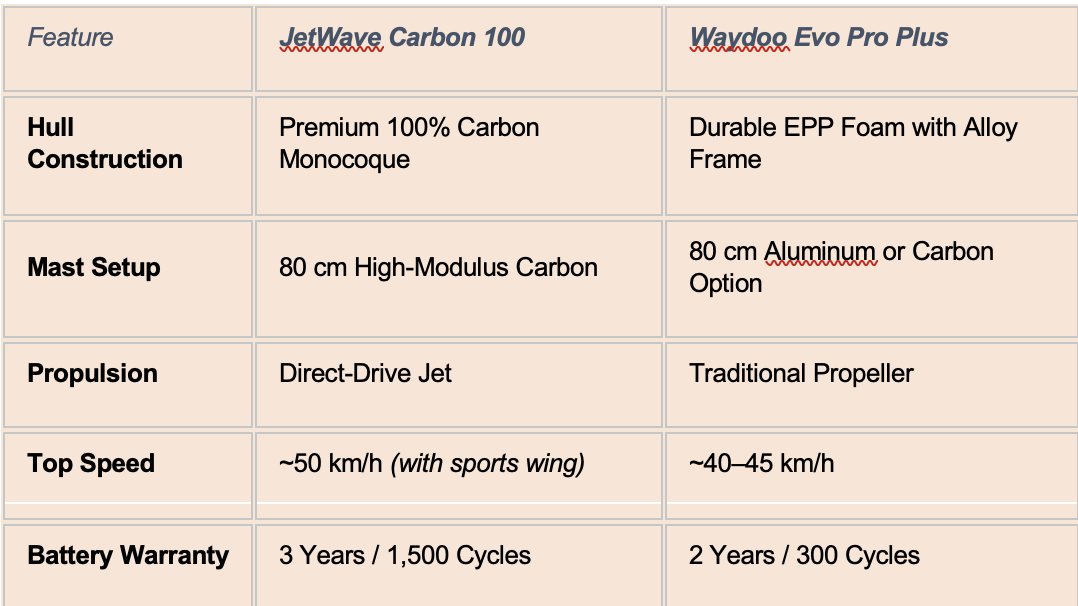
Hull Construction & Material Integrity
The contrast between these two setups becomes obvious before you even step off the dock: the build quality and material selection of the deck.
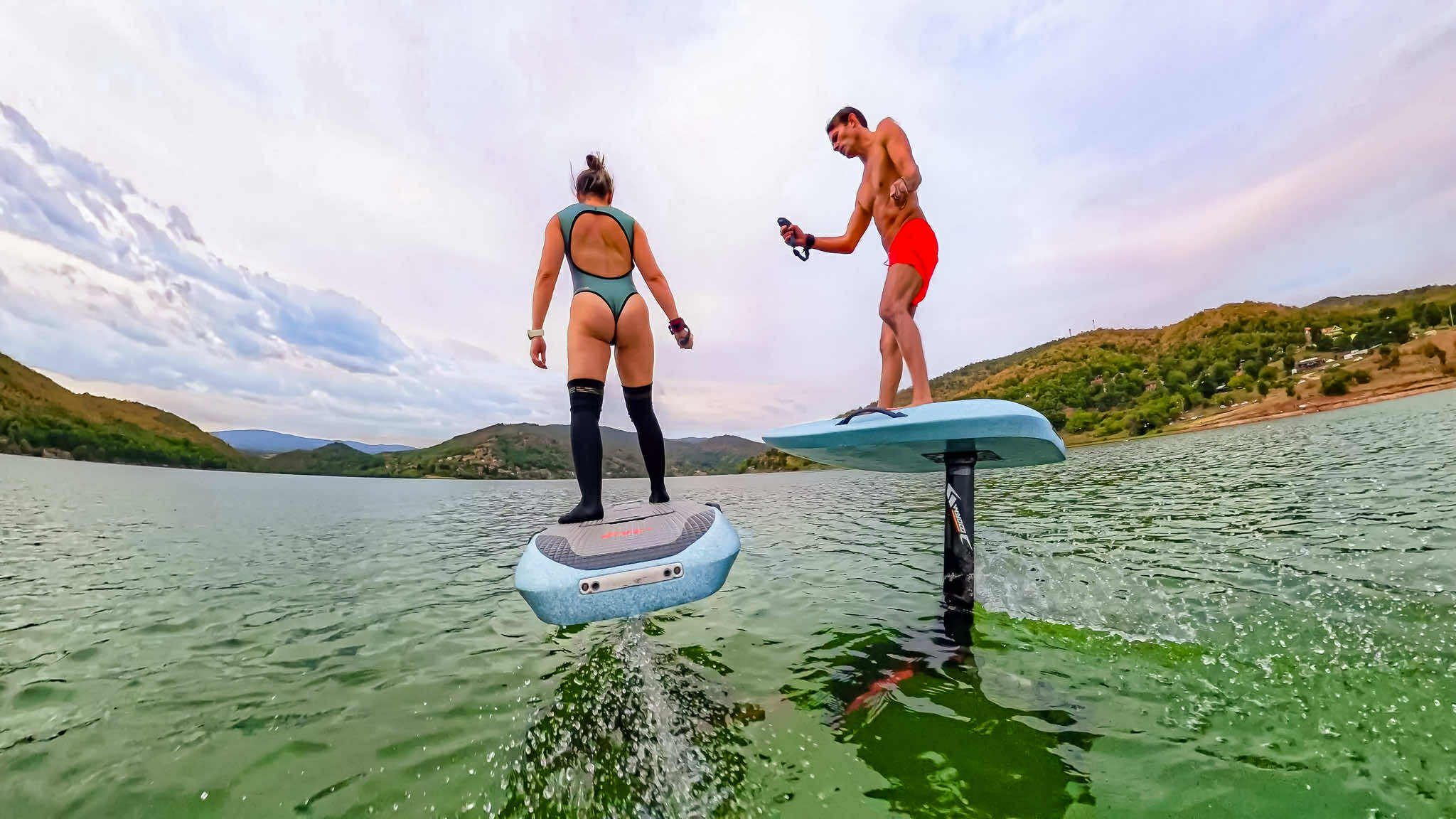
The Waydoo Evo Pro Plus
Waydoo targets the mass budget market, leaning on functional, cost-cutting materials. Built as a 90-liter expanded polypropylene (EPP) foam board around an aluminium alloy frame, it lacks the premium stiffness of carbon monocoque. Waydoo is comparatively heavy at roughly 37 kilos with the battery, though the foam is highly forgiving and easily repairable with EPP glue if you happen to nick a dock.
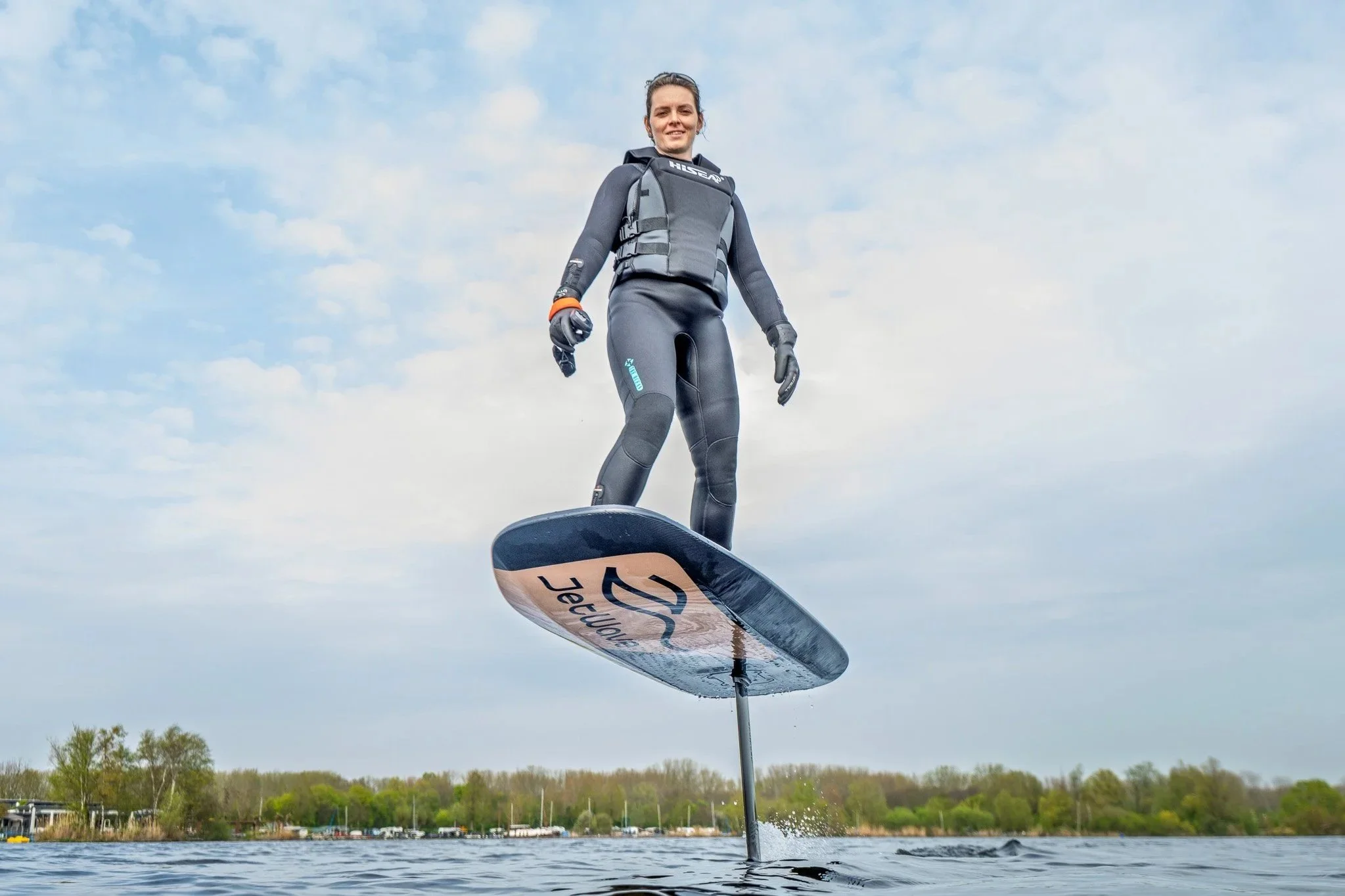
The JetWave Carbon 100
This board takes a luxury supercar approach to the water. Built with a flawless 100% carbon monocoque structure, it features high-quality woven HTCM carbon fiber with absolutely no cheap composites. The hull feels incredibly rigid, light, and responsive underfoot, dropping the total riding weight down to about 30 kilos. JetWave also extended the non-slip traction grip further back on the deck, providing a secure stance during aggressive maneuvers.
Link to JetWave
Real-World Riding Dynamics & Smart Tech
On-paper specs only tell half the story; the true divergence happens when these boards meet the water.
Waydoo's Flight Assistance
Waydoo attempts to smooth out the beginner learning curve with a built-in Flight Assistance System. Outfitted with gyroscopes and accelerometers, the board reads your height above the water and automatically adjusts power to prevent breaching or nose-diving.
While it acts like great training wheels to keep the board flat for straight-line cruising, Waydoo can feel restrictive as you advance. If you lean back to stand up or try to carve sharply, the system can mistake the pitch angle for an error and abruptly cut power. Furthermore, bright sun reflections on flat water can occasionally confuse the sensors entirely.
JetWave's Fluid Control
The JetWave Carbon 100 bypasses automated assists in favour of surgical mechanical feedback. Because the full carbon frame transfers every micro-movement of your feet directly to the foil, you feel completely in control.
Interestingly, real-world testing shows that beginners often get up and stay up much faster on the JetWave. This is largely due to its jet drive, which provides an incredibly silky, progressive acceleration compared to the sudden torque of Waydoo's propeller. JetWave also gives you massive flexibility with your setup, offering large 500, 350, and 200 back wings to dial in your stability, whereas Waydoo's stock stabilizers are limited to a single size.
Connectivity, Ecosystem, and Battery Innovation
The internal technology reveals exactly where the extra investment in a premium platform goes.
The User Experience
Managing a Waydoo board can come with a few minor friction points. Updating the remote controller firmware over a phone connection takes quite a while and is prone to failing mid-sync, and downloading ride maps presents a similar hurdle. There is also a physical quirk to note: water tends to collect inside the front of the board and will slowly drain out for days after a session, even if you try to blow it out with high-pressure air.
JetWave takes an entirely modern approach to connectivity. The Carbon 100 features worldwide 4G capability and real-time cloud syncing. Once you set up the Wi-Fi initially, the board automatically pushes your ride logs straight to the cloud—no phone tethering needed. The remote features a brilliant 2.88-inch interactive colour touchscreen and includes a dedicated one-click SOS button for offshore peace of mind.
Battery Lifespans
The battery technology is the most revolutionary difference here. Waydoo offers standard cylindrical cell packs with a warranty of 2 years or 300 cycles.
JetWave, on the other hand, introduces the eFoil industry's first semi-solid-state battery. Built using 12 large square cells instead of hundreds of tiny cylindrical ones, the pack is incredibly light (only 7.5 kg for the compact version) and exponentially more reliable. Because of this advanced architecture, JetWave provides a staggering 3-year warranty on the battery and rates it for over 1,500 charging cycles. As a bonus, JetWave's batteries charge in as little as 30 to 60 minutes with their supercharger.
Final Verdict: Which Board Fits Your Style?
Choose the Waydoo Evo Pro Plus ($6,500+) if you are working with a strict budget or want a durable, worry-free "family board." Its EPP foam construction means you can hand it off to friends without stressing about minor scratches or cosmetic dings.
Choose the JetWave Carbon 100 ($10,000+) if you want a zero-compromise, premium experience. If you appreciate high-end carbon craftsmanship, a incredibly smooth jet-propelled ride, seamless cloud tracking, and the ultimate long-term reliability of a solid-state battery backed by a 3-year warranty, it stands entirely in a league of its own.
JetWave Efoil Discount Code: MELANIE
Waydoo Evo Efoil Discount code: MelanieEU
I can set you in contact with the dealer in your area
JetWave Buyer FAQs
Q: Why does JetWave cost more than an entry-level eFoil?
The price premium is a direct reflection of uncompromising, commercial-grade materials and engineering. JetWave utilises full HTCM prepreg woven carbon fiber monocoque construction, meaning the board is incredibly rigid, completely seamless, and ultralight (the Carbon 100 hull is just 10.4 kg). Additionally, the integration of a proprietary, low-drag 6 kW brushless jet drive running at 16,000 RPM replaces traditional exposed propellers, offering a vastly smoother, safer, and more fluid carving experience.
Q: What is the true battery lifespan and charging speed of a JetWave board?
JetWave features an industry-leading 40-minute super-charging capability on its premium battery packs via a high-output 1200W fast charger. Built with honest materials, the Endurance battery pack utilizss high-capacity premium cells rated for over 1,000 charge cycles while maintaining nominal capacity—roughly double the lifespan of budget alternatives.
Q: Does the JetWave Carbon 100 perform well for absolute beginners?
Yes. While the Carbon 100 is engineered for ultimate high-speed stability and performance carving, its 100-liter volume provides exceptional buoyancy and a highly forgiving surface profile. The board's hull geometry is designed to prevent harsh sticking or suction during takeoffs and landings, completely eliminating the aggressive nosedives common when beginners transition to foil. It acts as a calm, confident cruiser that a beginner can easily learn on, but with a performance ceiling that allows them to progress to speeds near 50 km/h when paired with a sports wing.
Q: What does the JetWave 3-year global warranty actually cover?
Unlike competitors that exclude or heavily limit electrical components, JetWave provides a comprehensive 3-year global parts warranty for all retail consumers. Crucially, this policy explicitly covers the high-value battery unit and integrated ESC module alongside the carbon structural components, offering the strongest consumer protection on the luxury eFoil market.
Waydoo Buyer FAQs
Q: Is a budget eFoil like Waydoo actually reliable for long-term use?
Waydoo offers an accessible entry point into the sport, but the lower price point reflects its component build quality. While it is highly capable for casual riders, users frequently encounter minor electronic gremlins, such as Bluetooth disconnection between the remote and mast, app synchronization failures during firmware updates, and rapid wear on the battery bay seals. If you are a high-frequency rider, you should expect to spend more time on basic mechanical maintenance and troubleshooting compared to a premium brand.
Q: What are the hidden costs of buying a Waydoo eFoil?
Beyond the initial purchase price, potential buyers must factor in shipping costs for heavy lithium batteries, local import duties, and replacement parts. Because Waydoo's structural components (like masts and wings) utilize heavier aluminum and lower-grade composites rather than full prepreg carbon fiber, they are more prone to dinging, corrosion in saltwater, and stripping threads. Budgeting for backup propeller shrouds, specialised anti-corrosion marine grease (TEFGEL), and extra mast sealing rings is highly recommended.
Q: How does Waydoo's customer service and warranty handle part failures?
Waydoo handles support primarily through its global dealer network or online ticketing system. While they do honor manufacturing defects under their standard warranty period, shipping replacement batteries or major drive components can face lengthy delays depending on regional stock. Buyers should document all errors with video clips immediately, as technical support requires strict proof of failure before dispatching components.